

Mysterious Mulberries
Purple clothing and recollections of mulberry shadows


Photo by tabitha turner
There is nothing better than viewing historic properties, so to be told that my new office was to be an old house made me smile. First impressions of the Regency building proved favorable. The privet beneath the window needed trimming, the wrought iron trellis appeared to have lost its cast-iron porch and the path needed to be swept, but sadly for me these tasks lay with the team of gardeners. It was their domain not mine. A mulberry tree dominated the grass, and to the side of the house lay a small patch of garden planted with flowers.
A pinned-back outer door invited entry through a Gothic arch into a flagstone hallway with white walls and four doors. The doors were labelled but locked and the front entrance was bolted. Fire Door and Private notices prevailed. Momentarily feeling like a trespasser, I climbed the stairs to the first floor, to discover a domesticated workspace.
For years I worked near Bishopsgate, London, in an architecturally award-winning building. Thousands of employees dressed in black or navy complemented the corporate design of marble flooring, original artwork and lifts linking floors of exquisite neutral-schemed offices. Boardrooms, syndicate rooms, a bureau de change, swimming pool, salad bars and restaurants, meant there was no excuse to leave and to do so felt like an escape mission, something I noted:
‘I press the button for the lift back down from the sixteenth floor and watch the numbers descend. When the lift arrives I go in, stand in the corner with my arms crossed, wishing to be spirited somewhere else. With another thirteen floors to endure, people crowd up against me as if on the Tube. I roll my eyes and keep looking upwards, biting my lip until the ground floor, where I tumble out, smack my pass against the scanner to raise the barrier, smirk at the security guards, turn through the revolving doors and head out to the front of the building, where steel planters have been installed as floral barbed wire to counter any possible threats of terrorism.’
Historically, Bishopsgate was where merchants and traders lived, tucked away from the hustle and bustle. Built before the Great Fire of London, the facade of Sir Paul Pindar’s home near Liverpool St, is now in the V&A Museum.
In 1597, Pindar bought several properties at the north-east edge of the City of London on the west side of Bishopsgate Street, just outside the City walls. This was one of the main roads to East Anglia and had recently been paved. It was also convenient for Pindar's business activities. Less than a mile away was St Paul's Cathedral – a rendezvous for city merchants – and Cheapside, where traders also acted as bankers.
The City district has long associations with coffee houses (see ‘The Jam Pot’ hidden away in St Michael’s Alley, EC3V) and trading. More recently, those of us with no link to the trading floor would nip out of the office for boosts of coffee, expertly extracted for the caffeine. We often arrived at work early, having travelled by Underground, and took taxis home late at night. A strange existence in which it was easy to lose track of seasons. Comforting in some ways, restrictive in others. Very occasionally I would venture out of the Square Mile to Spitalfields, to admire the Georgian-era houses which would once have been homes and studios to French Huguenot weavers in the silk industry. With the decline of the silk industry around the 1760’s came the demise of streets such as Princelet St and Fournier St, before it was occupied by other interesting waves of residents.
With my new offices came another link with the silk industry, a mulberry tree with wide branches and wizened trunk. Someone had chosen to plant it during the Victorian era, possibly to soften the classical lines or as a nod to sericulture. Local archives list the residents during the 19th century as the owner, a local merchant, his relatives and servants.
I had the luxury of stepping outside to stand admiring the mulberries, in a private walled garden only streets from the centre of town. Two ducks wandered over from the nearby pond to sleep on the grass and a heron flew overhead, its wings pale against the blue sky. All so bucolic.
Gwen Raverat (nee Gwendolen Mary Darwin), member of the Bloomsbury Set along with her artist husband Jacques Raverat, referenced a mulberry tree in her account of a Cambridge childhood. Conversely, the anecdote is of leaving Cambridge to visit her Grandfather’s house, Down House, in Kent:
‘As soon as the door was opened, we smelt again the unmistakable cool, empty, country smell of the house, and we rushed all over the big under-furnished rooms in an ecstasy of joy. They reflected the barer way of life of the early nineteenth century, rather than the crowded, fussy mid-Victorian period. The furnishing was ugly in a way, but it was dignified and plain.
The nursery at Down had a white painted floor; it had green Venetian blinds too, and a great old mulberry tree that grew right up against the windows outside. The shadows of the mulberry leaves used to shift about on the white floor, and you could hear the plops of the ripe mulberries as they fell to the ground.’
(Gwen Raverat, Period Piece, Faber & Faber)
In spite of my love of berries (blackberrying, buying cloudberry jam in Stockholm, making summer pudding and growing non-edible snowberry hedges etc.) I had never tasted mulberries. They don’t travel well. Having checked that no-one was watching from a window, I reached up and picked a dark purplish-red berry from amongst the leaves, feeling juice drip down my hand and my arm. The berry tasted sweet and delicious. Glancing down towards my feet, I realised that my legs and feet were stained and so too my sandals. Heading inside and up to the first floor to wash, I left a trail, as had others, of footsteps resembling blood.
Maybe the servants of the house cursed the mulberry season, needing to clean up after them or shake the tree to release the fruit for jam; maybe they disliked getting up at 5am to clear ashes from the grate of the drawing room by paraffin lamp or candlelight, or maybe they took immense pride in managing the household. I could imagine living there and bringing it back to life, although it felt wrong to want to rip up the lino and the carpet, to strip the paint from the woodwork, open the shutters, and discover treasures in the attic or what would have been the scullery and was now a cupboard.
When I went into the kitchen it smelt of acrylic worksurfaces; the floor bowed underfoot; the woodwork had been painted over; and the paint had blistered. The door stuck and slammed and its handle rattled. Heading back along the landing I followed the mulberry-stained green carpet, to the blue one in the office, wondering if there would once have been Turkey rugs over floorboards. A colleague remarked that a recent visit to Sandringham reminded him of his grandparents’ house because of the colours. I had the same strange sensation, though nothing so palatial, from distant feelings of childhood, too tucked away to access. Maybe it was the sound of the sash window being opened, or the height of the ceilings, or the anaglypta. I wonder what happened to the furnishings and whether they had been consigned to storage.
I went out again for lunch and passed one of the outbuildings being tidied, as a job for August’s quieter period. Its contents were being thrown in a skip or stacked in a pile.
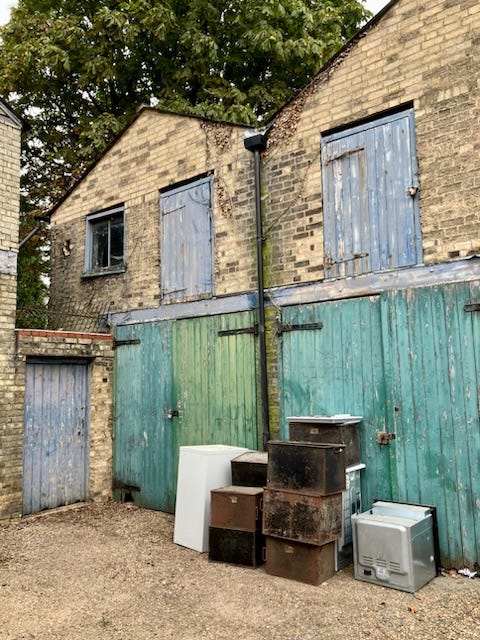
I longed to rummage in amongst broken ergonomic chairs and scratched saucepans but felt bound by the rules of the workplace. Besides I would not be able to transport a metal cabinet in my panier. I bumped into another colleague as I was wiping my shoes on the gravel and told her about the mulberries.
‘Wear a shower cap and purple clothing to pick them,’ she said. ‘And don’t get me started on foraging here, she said. ‘We’ll be here all day.’
A kindred spirit, more attuned to the mulberry season, with whom to share tips and clues about delights that might lie in plain sight. One day I shall request the keys to the drawing room and take in the view out onto the tree and what would have been a much larger garden, to make the most of the privileged surroundings.
I could imagine sitting at the table before my working day began, eating bread from a Spitalfields deli slathered with raw butter and black fig preserve, and Arabic with Spices coffee from the Algerian Coffee Stores, some of whose house blends have been on their menu for over 100 years. Alternately, I could bring in a flask of coffee, with hunks of soda bread still warm from the oven, and quick blackberry jam made from Nigel Slater’s recipe.
Mrs Beeton’s preserve would undoubtedly add authenticity, but it would require an awful lot of time and mulberry-picking. Besides this was not my home or garden.
PRESERVED MULBERRIES
1560. INGREDIENTS.--To 2 lbs. of fruit and 1 pint of juice allow 2-1/2 lbs. of loaf sugar.
Mode.--Put some of the fruit into a preserving-pan, and simmer it gently until the juice is well drawn. Strain it through a bag, measure it, and to every pint allow the above proportion of sugar and fruit. Put the sugar into the preserving-pan, moisten it with the juice, boil it up, skim well, and then add the mulberries, which should be ripe, but not soft enough to break to a pulp. Let them stand in the syrup till warm through, then set them on the fire to boil gently; when half done, turn them carefully into an earthen pan, and let them remain till the next day; then boil them as before, and when the syrup is thick, and becomes firm when cold, put the preserve into pots. In making this, care should be taken not to break the mulberries: this may be avoided by very gentle stirring, and by simmering the fruit very slowly.
Time.--3/4 hour to extract the juice;
1/4 hour to boil the mulberries the first time, 1/4 hour the second time.
Seasonable in August and September.Mrs. Beeton's Book of Household Management, by Isabella Beeton, 1861 - Recipes - Chapter 31 - Preserves, Confectionery, Ices and Dessert Dishes